



BY DAVE HURLEY
SACRAMENTO – Perhaps the greatest threat to California’s extensive system of connected waterways is a foreign invader that ranges from 1/2 to 2 inches in length. Since the golden mussel was discovered in October 2024, there have been a variety of approaches to limit their spread to the California Delta and the waterways of the State Water and Central Valley Water Projects. The Department of Water Resources is currently investigating methods of eradication, including chlorine, ultraviolet light, and chemical solutions, but nothing seems to stick except the mussels to every available submerged surface.
Within 15 months from discovery at the Port of Stockton in October 2024, the golden mussel is now found as far south as Silverwood Reservoir in San Bernardino County, the Coastal Aqueduct in Kings County, the Delta Mendota Canal, and Pyramid Lake in Los Angeles County.
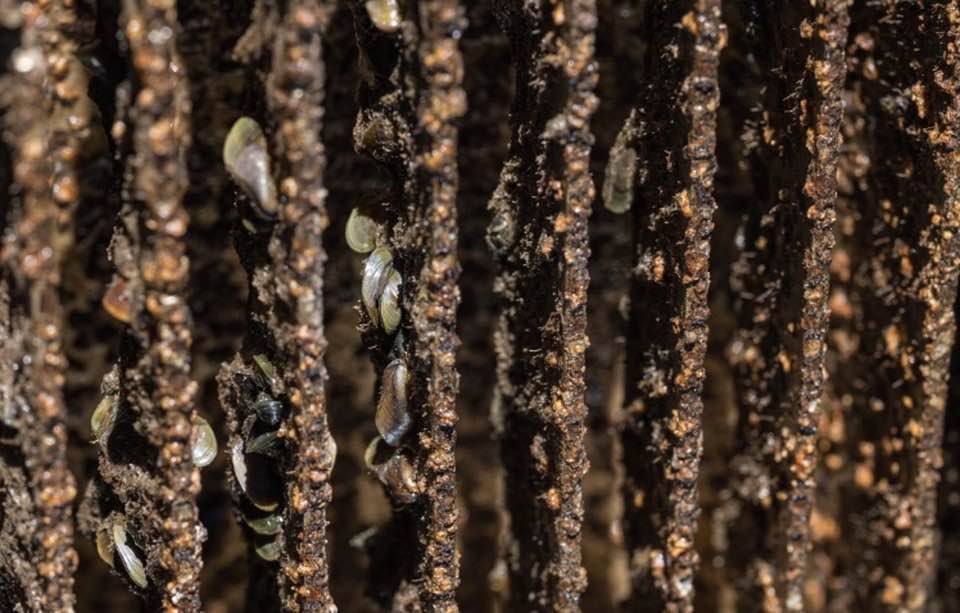
The golden mussel is a particular concern as they have clogged hydroelectric plants and irrigation systems in the Paraná River basin since the 1990s, costing Brazil $50 million a year in maintenance and agricultural losses. Hong Kong and Japan spend tens of millions annually to clean water intakes and treat algae-infested water with treatment costs up 15 to 20%. The mussels cluster on submerged structure, particularly intake farm, and storm drainage discharge pipes, leading to the potential inability to draw water or lead to flooding if the pipes are clogged. Pipes are an ideal location for mussel clusters due to the water movement bringing in food and oxygen to the stationary mussels. Estimates at potential damage to the Delta alone could exceed $500 annually. Golden mussels are clogging louvers at the Skinner Fish Facility near Byron, requiring weekly instead of monthly cleanings.

Invasive Species Corporation out of Davis, led by scientist Pamela Marrone is working to optimize Zequanox which is used to control quagga and zebra mussel for the golden mussel, and they found it can kill golden mussels, but not at a high a rate. She was quoted by KCRA as saying, “Golden mussels are much tougher to kill than Quagga and Zebra mussels. Unfortunately, once they’re invaded in a big way like they are, it’s not going back to normal. That’s why prevention is so much better than management. They’re so widely colonized now, it’s really going to be hard to eradicate them. So, the key here is to prevent them from spreading any further.” Despite grants including $2.5 million from the California Department of Fish and Wildlife and $20 million of state funds to the epicenter of the golden mussel invasion, San Joaquin County, the best solutions appear to be preventing the spread outside of the currently affected waters.
Boaters are frustrated due to inability to travel from lake to lake although decontaminated for one body of water. The approach to preventing their spread to reservoirs varies from reservoir to reservoir from a simple inspection for Clean, Drain, and Dry to a decontamination or 30-day banded quarantine. The golden mussel isn’t going away for some time, and with solutions stuck in neutral, boaters are the key to keeping the mussels out of California’s reservoirs because they aren’t going away like the mitten crab.
