


BY LOGAN SABELA
My son, Deacon, has been hunting with me since he was old enough to tolerate a few hours in the blind. The poor man’s elk, Meleagris gallopavo, has been the focus of our pursuits for the better part of a decade. While we eagerly wait each year for spring turkey to roll around, elk are in a different class of their own.
For a variety of reasons, success has eluded us on the last two of his hunts. His first cow hunt in Arizona was only a few seconds too late for a harvest. Last year, we found ourselves on a cow hunt again, but this time in Colorado. The first day presented a shot opportunity, but at a distance he was just not comfortable with. Of course, as things go, those were the only elk we saw the whole trip.
This year, I took a different approach. I applied for a low-draw unit in Colorado for archery and then put Deacon in for the same unit for first rifle. I obviously wanted to harvest a bull for myself, but more importantly, I hoped to get around and explore as much of the unit as I could. I figured if I had five or six options, we could hopefully turn up a bull. I ended up having a great spot where we got on elk about three to four miles back in a basin. The hunting pressure was not too bad, and with a little snow coming, I was hoping the elk would be up a little longer during daylight and easier to spot.
Opening morning, we were on the trail around 4:30 a.m. in order to get to our glassing spot by sunup. A few inches had already accumulated on the ground, and I was encouraged that we were the only vehicle at the trailhead. We began our ascent, and the 6-inch prediction was quickly eclipsed as our boots disappeared under the white blanket with each step. The trail began to disappear, and we grew tired pushing snow in near-whiteout conditions. When we went to put on Deacon’s gaiters, they did not fit. I reprimanded myself for not checking that before we left. Not one to quit, I tried pushing on. As the snow began to filter into my son’s boots, I knew our time here was limited. I contemplated making camp, but with snow showing no sign of slowing, I wondered what two feet plus of snow would do to our chances of pursuing elk, let alone getting one out.
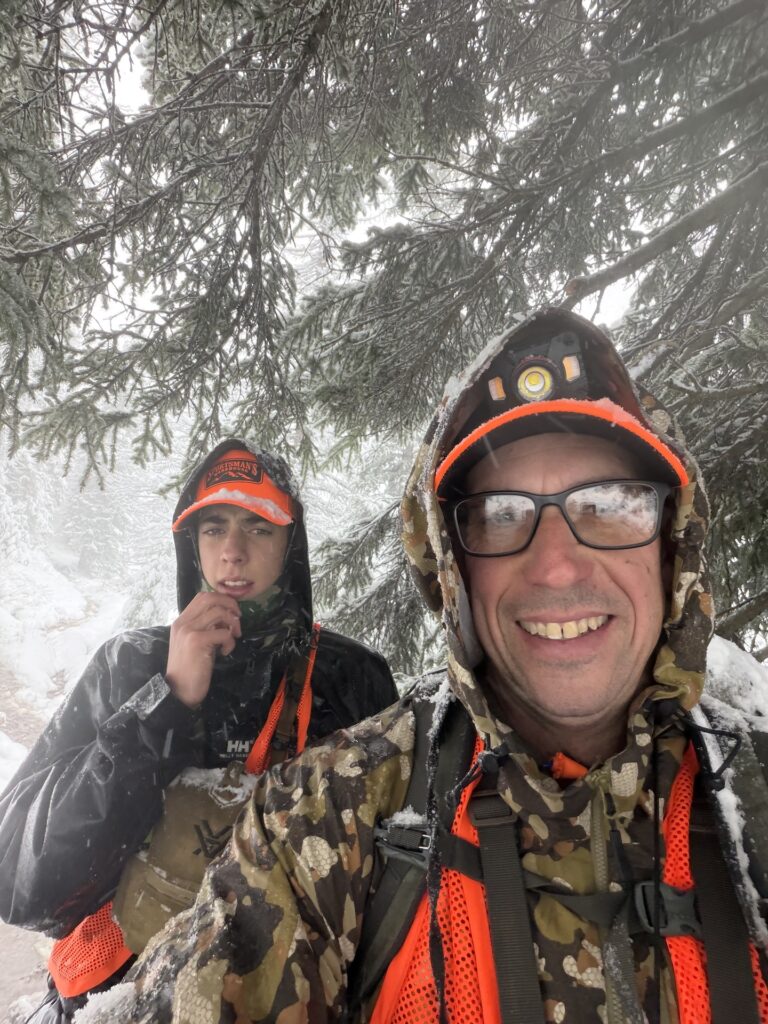
At three miles in, we reversed course, heads down, trying to avoid the sting of windblown snow pelting our faces. While I knew the direction we were heading, the trail continued to disappear as we marched back. With a few miles to go, Deacon rolled his ankle and required my trekking poles to get the rest of the way out. As I watched him hobble behind me, the reality of our trip coming to an early end permeated my thoughts. We were both glad to get back to the car and regroup. I wasn’t sure what the plan was going forward, but dropping in elevation and getting a hotel room seemed like a necessary reset.
The opportunity to grab some fast food and dry out our gear was a welcome break after the morning trudge. I jumped on my online map and began reviewing my waypoints from September. All of my spots required at least two to three miles of hiking, and it did not seem like my son’s ankle would be able to tolerate that. Was it time to call it? I hated the thought of heading home after just arriving. My son posed the question, “What if we road hunt?” To be honest, that had never been a thought of mine when planning a hunt. I had always been a get-into-the-backcountry kind of guy. “Well, it’s better than going home.” With all our plans scrapped for the moment, I started looking at what roads would offer some glassing opportunities.
With our gear dry and a full tank of gas, we started the slow climb back into the mountains. The pavement gave way to dirt and then to ruts with softball-sized stones, slowing our pace to a crawl. I began to question whether pushing on in our Durango was a wise choice. As we began to gain gray light, I saw a turnout opening up a large basin with some glassing opportunities. I questioned the bushes I was seeing as possible elk and kept scanning. My questions were answered as the bushes began to filter down to feed on an open hillside about a mile away.
“Elk!” My son snapped from his slumber.
“Can we get to them?”
“Not sure.”
At least we were in the game. We slowly scanned the elk for the sign of a bull. Up in the aspens, one looked a little larger than the others. I broke out our spotting scope and verified that one was a legal bull—all that he was after. We watched the hillside expecting them to feed off at any moment, in hopes we could see what direction they were headed. To my surprise, they stayed out for 2 ½ hours. This was contrary to what I had seen before and surely what I expected in a low-point general unit. I kept going back and forth between moving now and waiting.
I had been scrolling around on my map and thought I had identified the hillside they were on. I shared the waypoint with a friend of mine, and we both agreed that the ridge facing the hillside could be a good ambush spot if they returned. My son and I found a good spot to make our approach, and it was good we had waited. There was still a dusting of snow and frost on the ground, and what appeared on my map as a gentle slope down to the ridge was an angle just shy of vertical. Our first descent into the basin was more of a semi-controlled slide. Being midday, we had plenty of time to poke around and find some openings that gave us a clear view of the hillside the elk were feeding on. We settled in and waited for their return to feed that evening—my least favorite style of hunting. As dusk gave way to dark, it was clear it was not going to happen this evening.
“Let’s see what they do tomorrow,” I offered in encouragement.
Since it was such a chore to get down to that ridge, I decided to wait until first light and see if the elk were going to be there again. If they were, we would make the drop; if not, we would come up with another plan. It was a lazy plan, and we paid the price. As I scanned the edge of the treeline, I could see a few cows feeding around the aspens. I hoped that they were still working their way down, but it was quite the opposite. They disappeared like smoke, and I was left regretting not getting down there in the dark. The rest of the day went much like the day before—a great deal of sitting and glassing. We had time to poke around and discovered an even better vantage point on the ridge that I labeled as the “Sniper’s Nest” on my map. With the next day being Saturday, it was do or die. We needed to be on the road at some point to get home in time for work and school. I hoped we had witnessed a pattern, seeing them come out to feed on the exact same hillside two days in a row. The plan was to creep down an hour before light and see what happened.
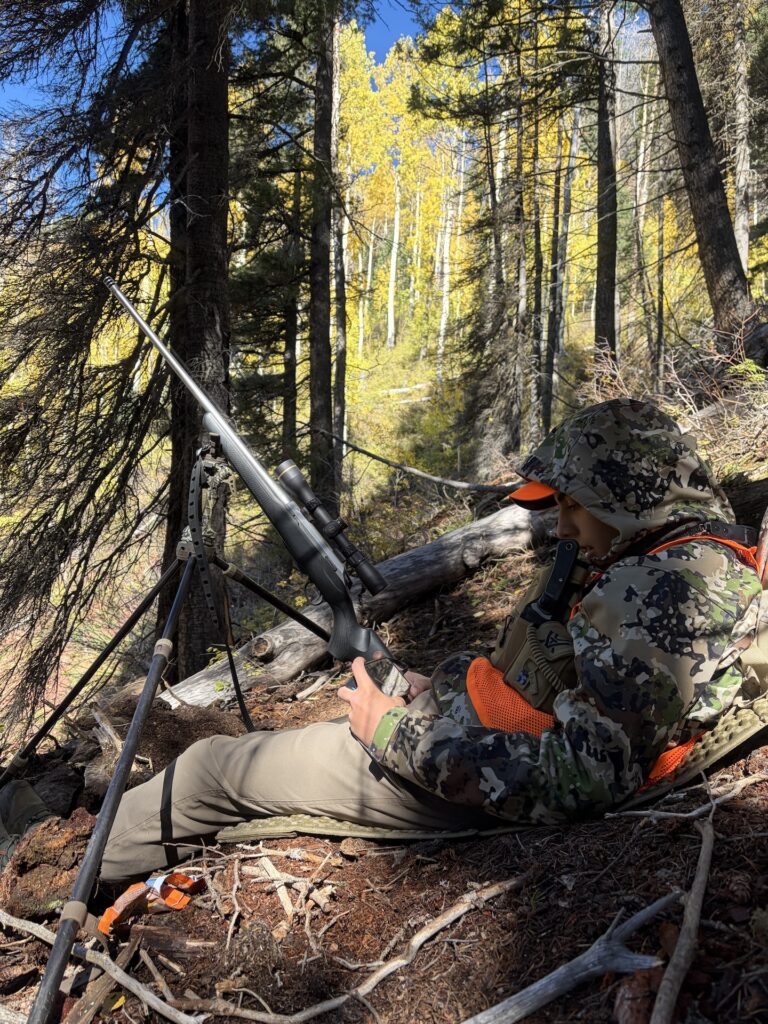
The last morning was filled with hope, but also accompanied by the familiar feeling of counting our moral victories on the return trip. We slowly crept down the hillside, planting our trekking poles before sliding down, and then repeating. It was a methodical descent, but we had given ourselves plenty of time. Deacon settled into his nest and began waiting for the hillside to reveal itself. The dark turned to gray, and I began scanning the tree line. Some shadowy figures began to emerge.
“Elk,” I whispered. “That one looks bigger than the rest.”
Soon we could tell that it was a legal bull, and Deacon adjusted his position as we waited for the right moment. The bull had cleared the couple of cows he was feeding around, and Deacon gave me the thumbs-up. I nodded as we both put our hearing protection on. I stayed on the glass and waited for the first shot to ring out.
“He’s hit.”
Deacon cycled another round as I confirmed the location of the bull. Deacon fired off three more rounds. I fumbled for another round as he prepared to reload when I saw the bull go down. I stayed on my binoculars to ensure he was more than stunned. His antler tips poking through the brush confirmed his condition, and we delayed our celebration no longer.
“We did it, we actually did it,” Deacon exclaimed in a hushed yell.
We high-fived and watched the hillside for a few more minutes. The cows continued to mill around in confusion, until at last they stampeded off, minus their bull.
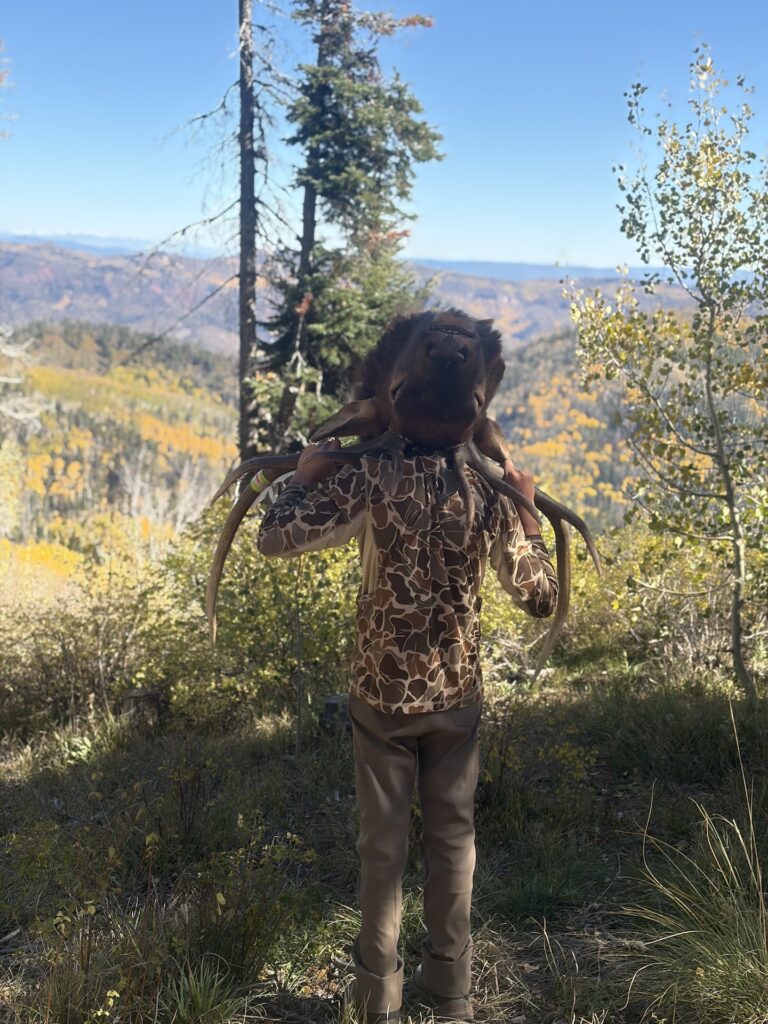
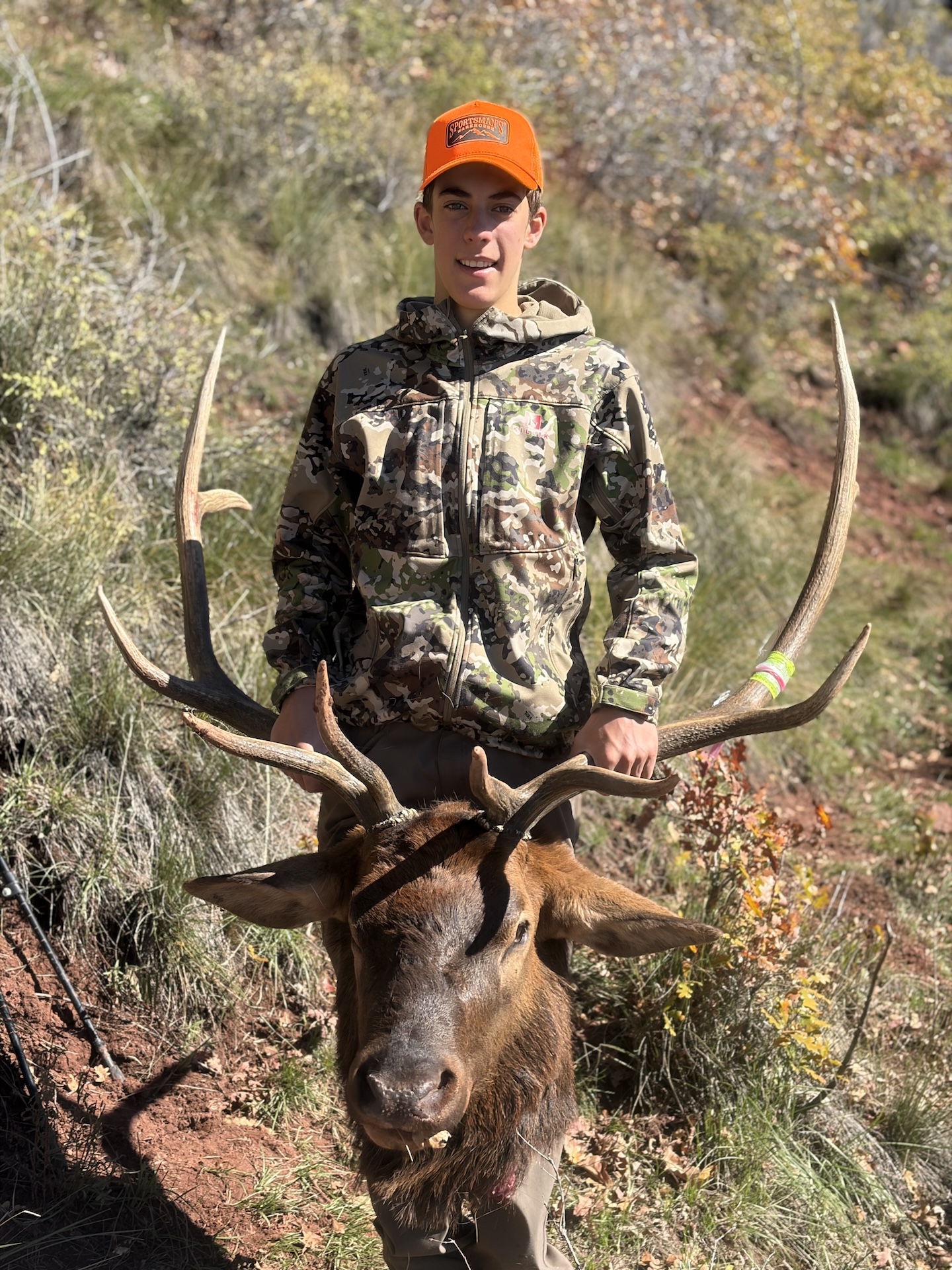
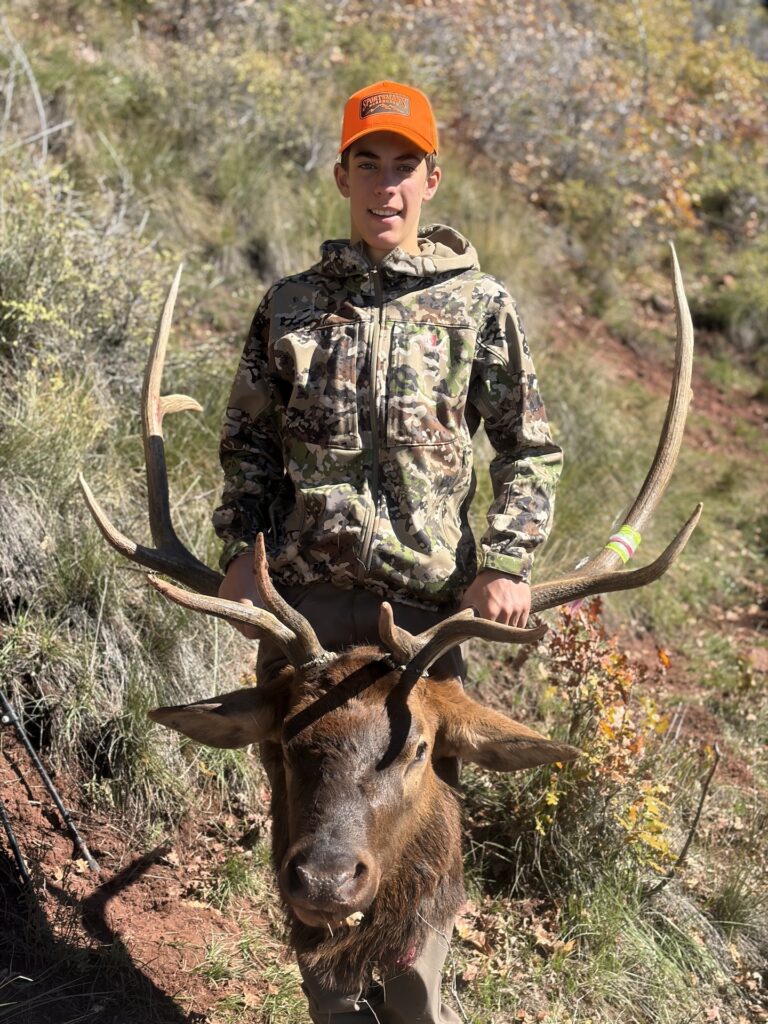
The walk over was surreal. I knew the elk was down, but in the back of my head, I needed proof that it was real. We slowly made our way over to where we had seen the elk drop, anticipation building. The hillside looked like a cattle drive had come through. The entire slope was filled with elk tracks, scat, and heavily used game trails. We rounded the corner and saw the rack poking through and the unmistakable tan hide. We hugged and yelped in excitement and then quickly called my wife to tell her the good news. She wouldn’t need to send out her obligatory morning text asking if there had been any success. We beat her to the punch. We stood there for a long moment, soaking it all in. The backdrop could not have been more perfect, nor the storyline leading up to this moment: excitement, hardship, disappointment, hope, determination, followed by success. We were on the board, and I could not have been more excited watching my firstborn wrap his hand around the chocolate-brown antlers as he straddled the bull. He was a nice 5×5 with big bases. We took a moment to thank God for the harvest and shot out a few more texts.
We jumped into the real work, and by noon we had the elk in game bags. Some nice gentlemen, also from California, volunteered to help us pack the rest out. We were only 500 yards from the road with an excellent game trail to follow out. The only way this could have been easier was if the bull had tipped over on the side of the road. The fact that these elk went undetected for as long as they did seemed like a miracle unto itself. We packed up the Durango and proudly strapped the rack to the roof. We quickly discovered that our second cooler was far too small for the front quarters. A quick detour to Walmart solved that problem, and my wife’s favorite cooler soon found a new home with a nice Colorado couple.
This drive home felt much different. For the first time, we were not recounting close calls or what we could have done differently. This journey home was full of congratulatory texts, and my son frequently checked the position of the rack on the roof. We deserved none of this. The entire hunt felt scripted and served as a great reminder of what can happen when you grind it out. I have heard of last-day successes and how they seem to be the norm among many hunters.
My son was proud to add his name to the long list of last-minute successes and go home heavy.