



BY Merit McCrea
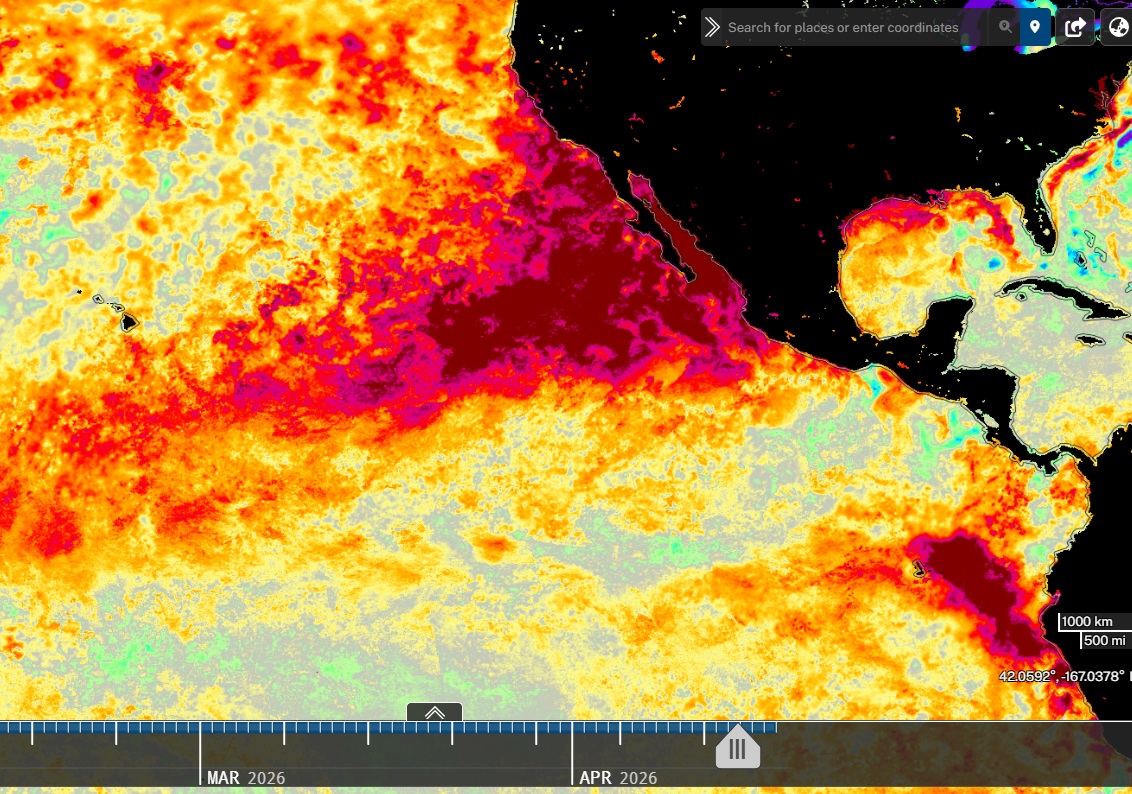
SAN CLEMENTE – In case you haven’t noticed, our California waters have been pretty warm for this time of year, and rumors of El Niño and even SUPER El Niño are surfacing. Everyone is talking percentages – 30% chance of El Niño – or fill-in-the %. But what’s been happening is even crazier.
Back in 1983 the biggest departure from normal was maybe 7 °F above normal, but April is typically the coldest water month of the year and temps have been into the very high 60s, like 10-plus degrees above normal.
People are surprised it’s not January that’s coldest, but it’s the late March and April northwest winds that come with warming inland areas and inside slider weather fronts that drive coastal upwelling and butt-cold coastal waters.

What happened was some really calm March conditions plus the in-general northerly transit of warmer waters all across the North Pacific. Equatorial waters are warm as always, polar waters are cold as ever, but the mid-latitude waters are trending warmer than usual, as if the equatorial warmth was radiating northward (southward too it seems).
The warm waters we saw in the last month are actually not associated with “El Niño” in the way climatologists and physical oceanographers describe it. But what’s now being called a “marine heat wave” like the “Blob” in 2015.
As for El Niño, just the beginnings of warmer than average waters are starting to show in the waters west of Ecuador. In normal conditions that area has upwelling as the northern and southern trades plus Coriolis effect whisks equatorial surface waters away from the equator there. Warm water typically piles up in Indo.
El Niño is when the trade winds slow and with it the “normal” equatorial upwelling with it. Right now we can see from satellite data the very beginnings of warming waters off of Ecuador.
But at the same time there’s a giant triangular blob of warm water extending northward into Washington, southward to Puerto Vallarta and westward all the way past Hawaii to the island chain’s southwest. Southern warm waters have pushed northward along our coast.
Temperature differences from usual for this time of year are outrageous, greater than anyone has ever seen since we’ve been able to see it (which really hasn’t been very long, maybe the past 50 years or so).
But in the past week we’ve finally seen some strong and persistent northwesterlies and strong upwelling.
So how cold is that water that’s being drawn up from the depths, 100, 200 feet down? Off of Point Conception the usual is about 51 degrees, temps right at the point right after a big blow can be 50°F or 10°C. In the late 70s we saw 46-degree water. In 1995 it was like 49 °F, and down in the channel, surface temps were 52 to 54 with salmon everywhere. What came up from the depths recently was 13°C at the very coldest. That’s 55.4 °F – still about 4 degrees warmer than usual deep water for the area.
Not only is the surface water crazy warm for this time of year, but it seems the deep water up-welling is also warmer.
Whether El Niño arrives here or not, it’s looking like we will be in hot water this year.
