



BY NICK HEID
Special to Western Outdoor News
SurfFishingSoCalSD.com

SAN DIEGO – On June 17, the California Fish and Game Commission voted unanimously to approve an emergency regulation banning wire leader and hooks over 1.5 inches for anyone fishing the ocean from Pigeon Point south within 1,000 yards of the shore, essentially the entire Southern and Central California shoreline. This measure moved forward with little opportunity for the thousands of anglers it affects to weigh in before the vote, resulting in a unanimous yes, and a five-day clock for the public to respond after the fact.
The stated goal is to reduce white shark interactions with swimmers. Meanwhile, the unintended consequence will be a dramatic increase in the number of sharks swimming around with hooks and fishing line left in their mouths after breaking off weaker monofilament leaders. Many of these sharks would have otherwise been successfully landed and safely released if anglers had continued using wire. This will do real, measurable harm to a sustainable fishery that has nothing to do with the problem. The other unstated (yet seemingly intended) consequence will be that shore anglers targeting larger species of sharks like makos, threshers and other species will no longer be able to effectively do so.
What the regulation actually does
The new rule prohibits wire or metallic leader and hooks larger than 1.5 inches in inside measurement when fishing in ocean waters from Pigeon Point south within 1,000 yards of the shore. Rather than focusing narrowly on those illegally targeting white sharks, the regulation applies broadly to anglers pursuing a variety of shark species along much of California’s coastline.
Leopard sharks, Soupfin sharks, sevengills, threshers and makos. None of these are the problem this regulation claims to be regulating. All of them are now caught under the same gear restriction as if they were.
One thing that wasn’t clear to me when I first read the notice, but it became clear after speaking with representatives of the Commission, is that this measure is not aimed solely at great white sharks. Their intent is to prevent anglers from hooking and landing any large shark species that could potentially pose a risk to swimmers in the area.
While some may view that as a clarification, many anglers see it as an even greater overreach that further restricts access to a significant part of our local fishery. This is especially true for those of us who do not have the means or opportunity to fish from boats, whether due to financial limitations or simply a lack of access.
Unintended consequences
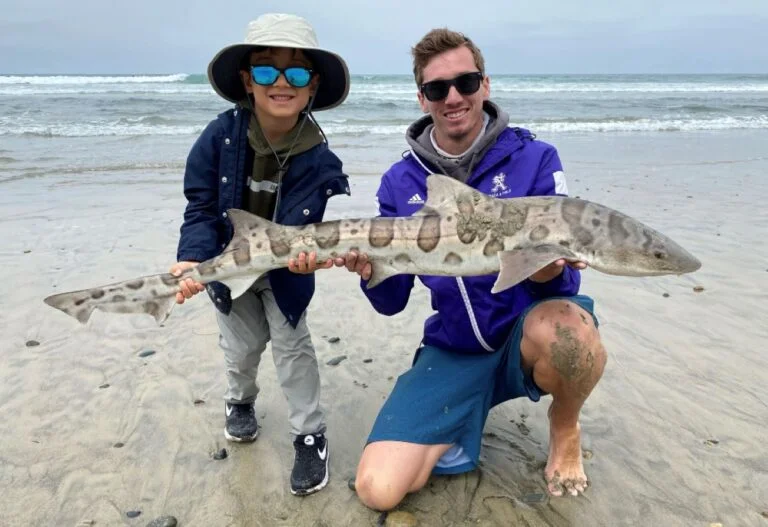
I am one angler. In a typical year I hook [and safely release] somewhere around 50-plus leopard sharks from the surf and show great appreciation and admiration for these incredible species. In a strong year, I’ve topped 100, releasing every single shark – healthy and strong. I am one of thousands of recreational surf anglers fishing this coast, season after season, doing exactly what California’s constitution says we have the right to do: fish.
If wire leader disappears, here’s what happens to a meaningful share of those leopard sharks, soupfins, and sevengills hooked by me and every other angler like me. They don’t all get landed cleanly, unhooked, and released the way they do now. Unfortunately, some will break off, and swim off with a hook and a length of monofilament line still attached. That fish doesn’t disappear from the ecosystem unaffected. It carries that gear with it – at least for some time.
Now multiply that by every angler on this coast targeting these species, for every season this regulation stays in effect. The Commission is trading a documented small number of interactions against an uncounted, unexamined number of leopard sharks, soupfins, sevengills, threshers, makos and more species that will now be hooked and lost rather than hooked and safely released.
Hook Size Restriction – Negative Effects
There’s a second piece of this regulation that’s gotten less attention and deserves more: the 1.5-inch maximum hook size.
I fish 7/0 to 9/0 circle hooks for leopard sharks and soupfins. Those hooks are smaller than the new limit, so on paper I’m fine. But anglers targeting sevengill sharks, threshers, makos, and other larger species of fish that require larger gear because of their size and the way they feed, are now being pushed toward smaller hooks than what’s appropriate for those species.
Here’s why that matters. A properly sized circle hook is designed to find the corner of a fish’s mouth almost every time – a clean hookset that’s easy to remove and minimizes injury to the fish and risk to the angler. Force an angler onto undersized gear for the species they’re actually targeting, and you increase the odds of a deep hook, a swallowed hook, gut hooking, the exact kind of injury circle hooks were popularized to prevent in the first place. If this regulation goes through, it will make injury more likely for the sharks and anglers.
That’s not a side effect. That’s the direct, foreseeable result of the rule as written.
The Department of Fish and Wildlife is taking action to keep public safety, but they’re doing so in a broad, sweeping manner that undermines those practicing legal and safe fishing. They’re actively making it near impossible for those targeting larger species of sharks like makos, threshers and even sevengills and more from land.
There are a small number of bad actors illegally targeting great white sharks and breaking the law is inherently bad. But those breaking the law will continue to break the law unless caught and disciplined. And while there have been a few isolated incidents where public safety concerns arose, there are far more anglers who fish responsibly and exercise their constitutional right to fish in a lawful and ethical manner that do not deserve to be subjected to the ensuing restrictions.
A Compromise: Not Perfect, But Better
First and foremost, I believe that any shark species with a healthy and sustainable population should remain a legal target for recreational anglers. From a fisheries management perspective, it makes little sense to distinguish between species solely based on perception, when populations are healthy and harvest or catch-and-release practices are properly regulated.
However, even if the Commission’s objective is to make it more difficult for anglers to intentionally target large shark species that could pose a greater risk to public safety, I do not believe a complete prohibition on wire leaders is the most reasonable solution. A more balanced approach could be to establish maximum leader lengths or strength limits that would discourage the targeting of very large sharks while still allowing anglers to effectively and safely pursue smaller, commonly encountered species.
At a minimum, such an approach would provide substantial benefits for species such as leopard sharks, soupfin sharks, and other smaller sharks that make up an important part of California’s inshore fishery. It would also improve angler safety by allowing fishermen to maintain better control of hooked fish and complete quicker, more efficient releases. While I personally believe all healthy shark populations should remain available to anglers, a more tailored regulation would better balance conservation, public safety, and responsible access than a blanket ban on wire leaders.
