



BY Merit McCrea
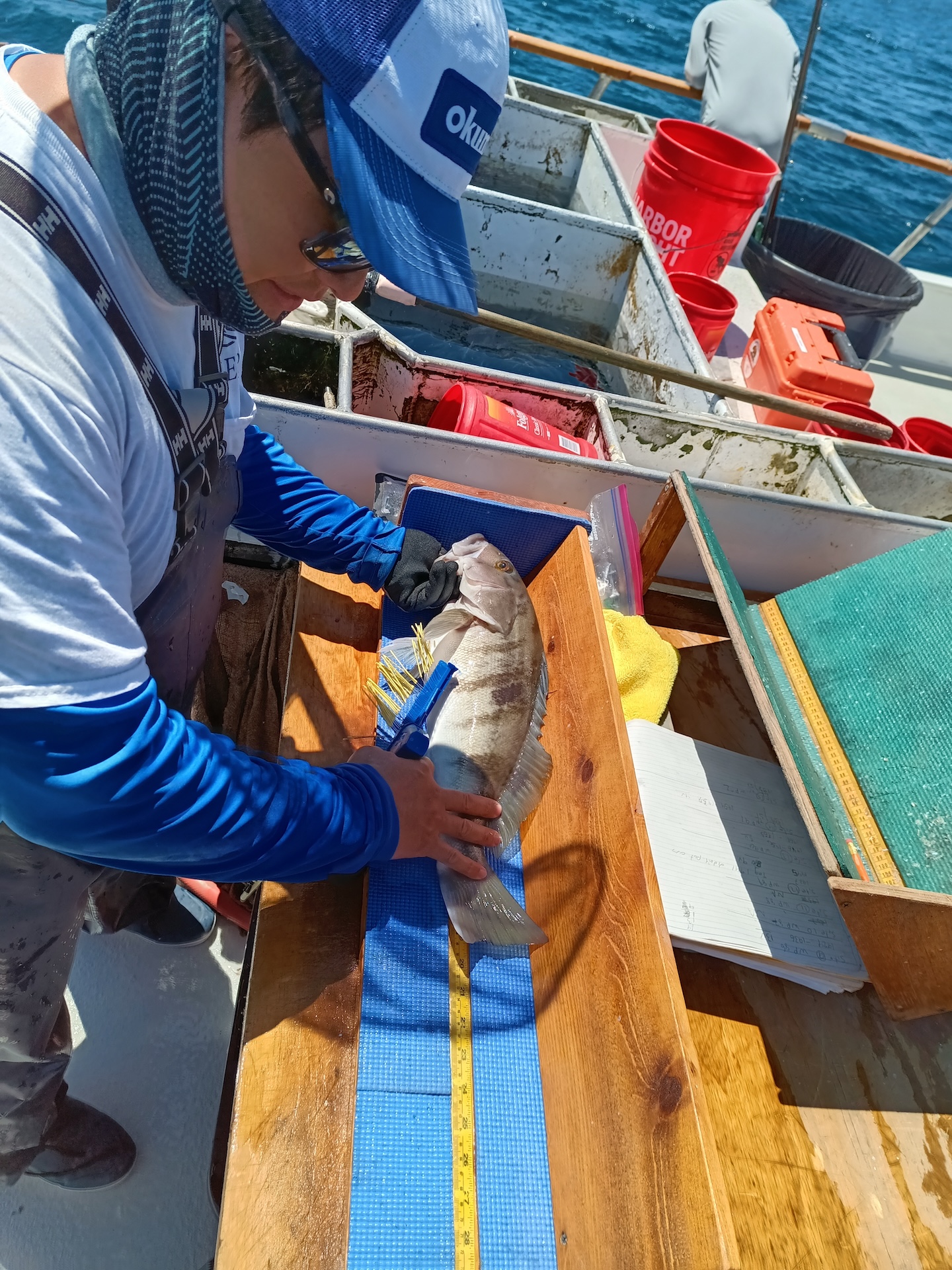
TIJUANA, MX – The team at the Pfleger Institute of Ecological Research or PIER tagged its one thousandth sand bass ths year, at or below the Mexican border. The tagging project is to see whether sand bass move across the border and if so, by how much. When the big sand bass bites happen in SoCal some summers it’s always seemed like there were far more sand bass in those massive schools than could ever be accounted for here during the rest of the year. In the past skippers have literally followed the front as schools moved northward through the Bight. More southerly ports saw the schools move back through later in the summer as well.
But no tagging study has previously been done on both sides of the border. For fish tagged in US waters there wasn’t a recovery effort south of the border, so for the first time we’re tagging fish in Mexican waters to see if tags show up in US waters. PIER’s tagging effort is supported by the Sportfishing Association of California (SAC) – our fleet, in collaboration with scientists and fishermen in Baja. The partners in this work are Baja California Pesca, Centro de Investigación Científica y de Educación Superior de Ensenada, Baja California (CICESE), Autonomous University of Baja California (UABC), PIER and SAC.
Sand bass have been tagged out of several fishing cooperativos as well as aboard the boat Pt. Loma out of Pt. Loma Sportfishing owned by Capt. Fred Huber. The final of a 4-charter series of tagging trips wrapped up on the 19th, bringing the current total of tagged sand bass to 1,075. Each tag carries contact info and a unique id number.
There is reward and more for turning in a tag number with the date and location of the catch. Anglers can keep legal sized fish or release them. Just photo the tag #, or write it down and turn it in to www.pier.org/sandbass or call the phone number on the tag.
More fish are still being tagged by local fishermen out of Mexico too.
The tagging project is one of several and SAC is also taking volunteers to measure sand bass on sport boats throughout the Bight. To volunteer contact Maria at (619) 313-0427 or Sacofficehelp3@gmail.com. The CDFW is conducting a natural tagging project as well, looking for local microchemistry signatures and genetics in sand bass from both California and Mexico and have completed sample collections in Baja.
