


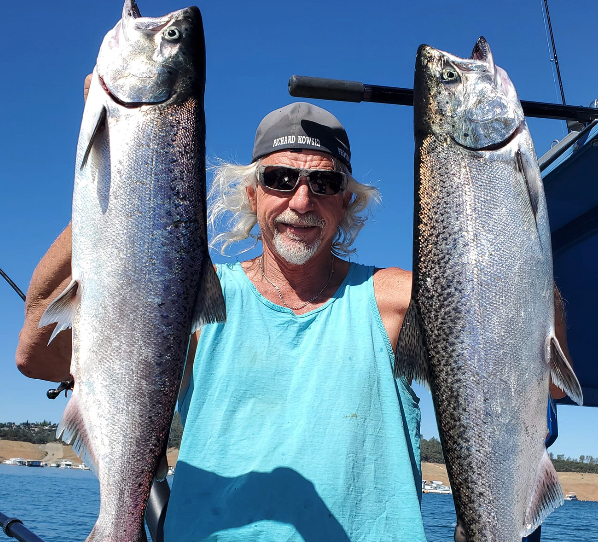

NO KINGS FOR OROVILLE THIS YEAR – Or Shasta, Folsom, or another other body of water with a downstream hatchery due to the threat of the virus IHN. Oroville, Shasta, and Folsom are expected to produce quality kings for the next two years, but 2027 will be a different story. Richard Kowski with a pair of quality Oroville kings. Photo courtesy of Richard Kowski.
By Dave Hurley
WON Staff Writer
SACRAMENTO – The California Department of Fish and Wildlife held their annual meeting with inland salmon/kokanee stakeholders to address the status of the 2025 spring plants. Inland salmon eggs are collected by the Feather River Hatchery in Oroville, and this year’s eggs were heavily infected with Infectious Haematopoieti Necrosis (IHN), an infectious viral disease for both salmon and trout first spread across North America in the 1970’s by rainbow trout. Garry Erck, President of the California Inland Fisheries Foundation, Inc., was present during the meeting, and he said, “INH is present every year, but this is an exceptionally bad. It is expected to show up at these levels every 5 to 6 years, and it has been 8 years since the last bad year. The department was able to meet their egg take goal of 1.2 million, but after testing, three of the four lots were destroyed due to the presence of INH. A single lot of 300,000 eggs have the only potential for planting this year. There is another test scheduled for April, and if the lot fails the test, the eggs will be destroyed, resulting in no inland king salmon plants will occur in 2025. If the eggs are still viable after April testing, the 300,000 salmon can only be planted in lakes with no downstream hatcheries, potentially Berryessa, Spaulding, Don Pedro, and Pine Flat. No other lakes will receive an allotment in 2025.”

The mortality rate of IHN can be 100% in fry, and any fish that survive an IHN outbreak can become carriers of the virus, thus the reason for only planting lakes without out a downstream hatchery. The inland king fishery at Shasta, Oroville, and Folsom have been extremely popular with fish over 10 pounds, but these lakes are unable to receive a 2025 plant. In 2024, the department planted over 992,00 inland Chinook salmon in 13 reservoirs in northern and central California.
Regarding kokanee plants, Erck added, “The egg take goal from the inlets of Stampede Reservoir was 1.8 million, but the actual take was 1.4 million with 1 million currently surviving. The eggs are being hatched at the San Joaquin and American River hatcheries with a final count in 60 days. If the numbers maintain, the 2025 kokanee plants will take place across the normal lakes as the annual kokanee allotment is 750,000.”
During spring 2024, 538,000 Kokanee salmon were stocked in 13 reservoirs that from Shasta in the north to Shaver Lake in the south. In 2024, kokanee fishing was outstanding throughout northern California except Berryessa and Bass Lake. Erck added, “The plankton in Berryessa is down this year, and the department’s biologists have not determined the reason. There has been three years of high water, but the plankton has been absent. It seems Berryessa will continue to be a challenge for kokanee going forward.”
Unfortunately, king salmon plants will be either non-existent or limited to a few lakes, but there is good news overall on the kokanee front for the coming spring plants. Kokanee planted this spring will arrive as 3rd-year adults in 2027.
